
Deerfield Township Previous Residents Sources
Previous residents research has a clear order. The Warren County Auditor establishes the current parcel, account number, ownership record, and legal description. The Recorder’s AVA route then uses the parcel, party, or document information to locate recorded transactions. Historical household evidence comes later from census schedules, county directory leads, newspapers, and estate or cemetery material. Each source answers a narrower question, and none should be stretched to prove more than it records.
| Source | Years It Covers | Where Held | What It Shows |
|---|---|---|---|
| Recorder deed index | Through 1797, as stated | Warren County Recorder and AVA | Recorded property and document trail, not every occupant |
| Online document notice | Most documents findable online since April 20, 2016 | Recorder route | Practical online document access; older work may need an office or archive |
| Records Center historic indexes | Holdings from 1803; 75 years and older accessible for research | County Records Center & Archives | Deed inventory, maps, court, probate, and tax-history leads |
| Wiggins Warren County Directory | 1878 | WCGS route | County historical lead; its entry fields are uninspected |
| Federal census | Through 1950 public release | National Archives and affiliate platforms | Household evidence on the census date |
Start with the current parcel even if the question begins with a street address. AVA disables address search, so a street-only approach stops at the Recorder. The Auditor’s parcel and legal-description fields create the handoff. Older places and street labels require special care because no verified Deerfield Township renumbering record, local house-history guide, or Sanborn coverage was found.
Parcel First for Deerfield Township History
The Auditor Property Search is the first official stop for a property trail. It offers owner-name, address, parcel ID, account number, subdivision or lot, and advanced modes. A result grid can show account number, owner name, parcel number, physical address, subdivision, and lot. A summary or linked mapping record adds the legal-description context needed for older documents. Keep the physical or situs address separate from tax mailing fields. A tax contact address does not show who was physically present at the property.
Copy the 10-digit parcel number and the legal description exactly as returned. The Recorder’s instructions specifically identify the parcel number as the useful bridge from Auditor results to AVA. The account number can also help preserve a clean research trail, but do not replace the legal description with a modern street label when searching earlier records.
Deerfield Township Previous Resident Deed Chain
A chain of title follows recorded transfers, not a complete roll of prior occupants. Find the present owner and legal description in the Auditor result, then use AVA by parcel, name, document, date, book, or page. AVA has no address field. Read the document’s recorded date, parties, recording information, and legal description before moving to the prior transaction. The Recorder says its deed index reaches 1797, while its notice that most documents became findable online on April 20, 2016 is a separate statement about practical online access.
- Open the current Auditor parcel record and preserve the parcel number, account number, current owner, and legal description.
- Use the parcel, party name, or document details in AVA to find the current owner’s recorded acquisition.
- Read the grantor, grantee, recording date, document type, and legal description rather than relying on the current street address.
- Search the prior party or the same parcel to locate that party’s earlier acquisition, then repeat the process backward.
- For an older or incomplete online trail, use the Recorder, AVA index, Records Center deed inventory, reading room, and WCGS land-record guide.
- Grantor and grantee
- The grantor transfers an interest in a recorded document. The grantee receives that interest.
- Chain of title
- The sequence of recorded transfers attached to the same property interest over time.
- Legal description
- The parcel’s recorded land description. It holds continuity better than a changing street label.
- Recorded party
- A person or entity named in a filing. That role does not by itself prove a residence at the property.
AVA Records for Deerfield Township History
The Warren County Recorder reports that all deeds are indexed online through 1797. AVA’s available fields include first name, last or business name, start and end dates, document number, document type, book, page, and parcel. At least one field is required, wildcard searching is enabled, and address, municipality, subdivision, and tract searches are disabled. Those controls explain why the prior parcel step is essential for tracking Deerfield Township previous residents through recorded property history.
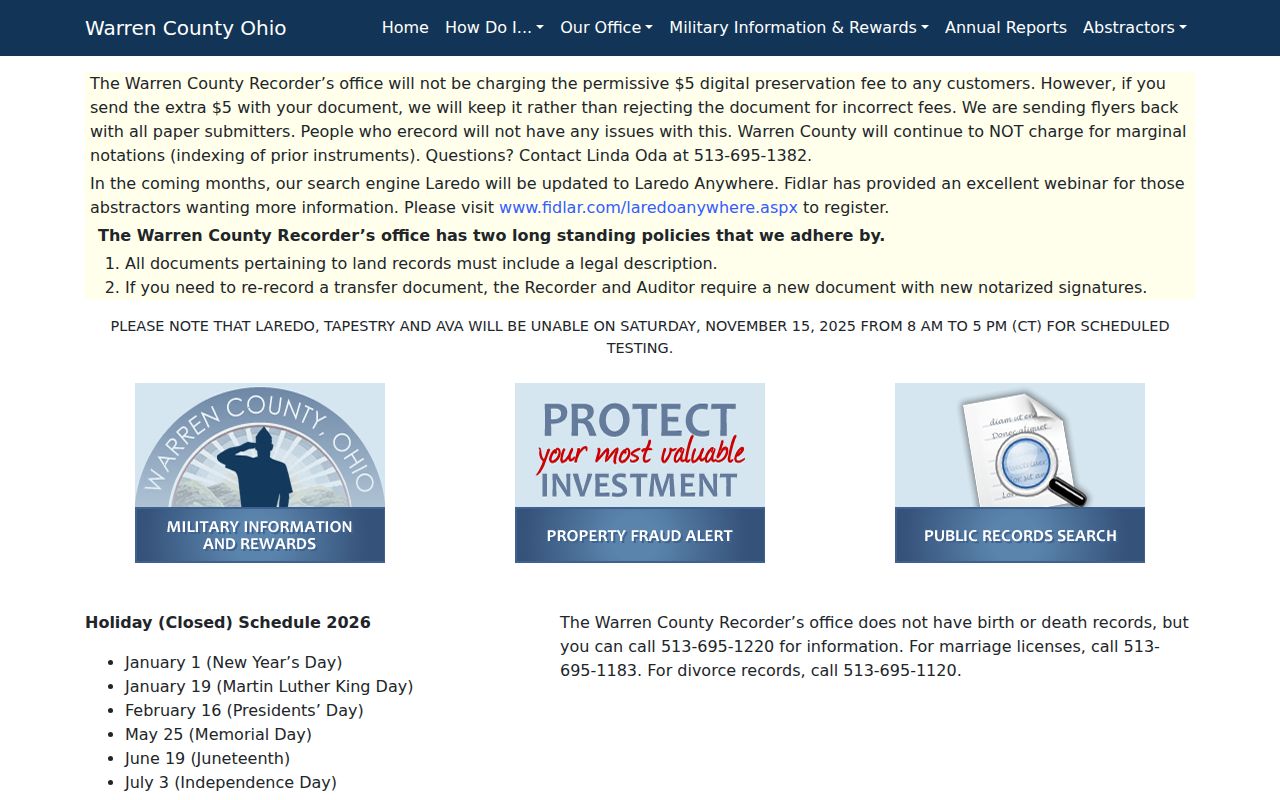
AVA result headers identify document number, document type, recorded date, Party 1, and Party 2. Details can support document, book, page, party-role, legal-location, parcel, consideration, fee, and image information where available. An individual result screen was not inspected because of CAPTCHA, so field availability on a particular document should be checked in the live portal or with the Recorder.
Deerfield Township Previous Residents Archives
The Records Center & Archives is the older-trail fallback. Its collection holds county records at least 75 years old, with material dating to 1803; newer records go to the department that created them. Its index screen lets a researcher select a department and index, use partial or variant spellings, browse, filter, and sort. A “View Document” link means a scan is available for that specific entry. No link does not mean the record is gone.
County Archives indexes include the Recorder Deed Index, Miscellaneous Maps, Engineer Maps/Drawings/Aerials, historic court and probate material, and other county series. Record a volume and page from a deed-inventory result, then use it with the Recorder follow-up. The archive offers paper, electronic, and microfilm reading-room access.
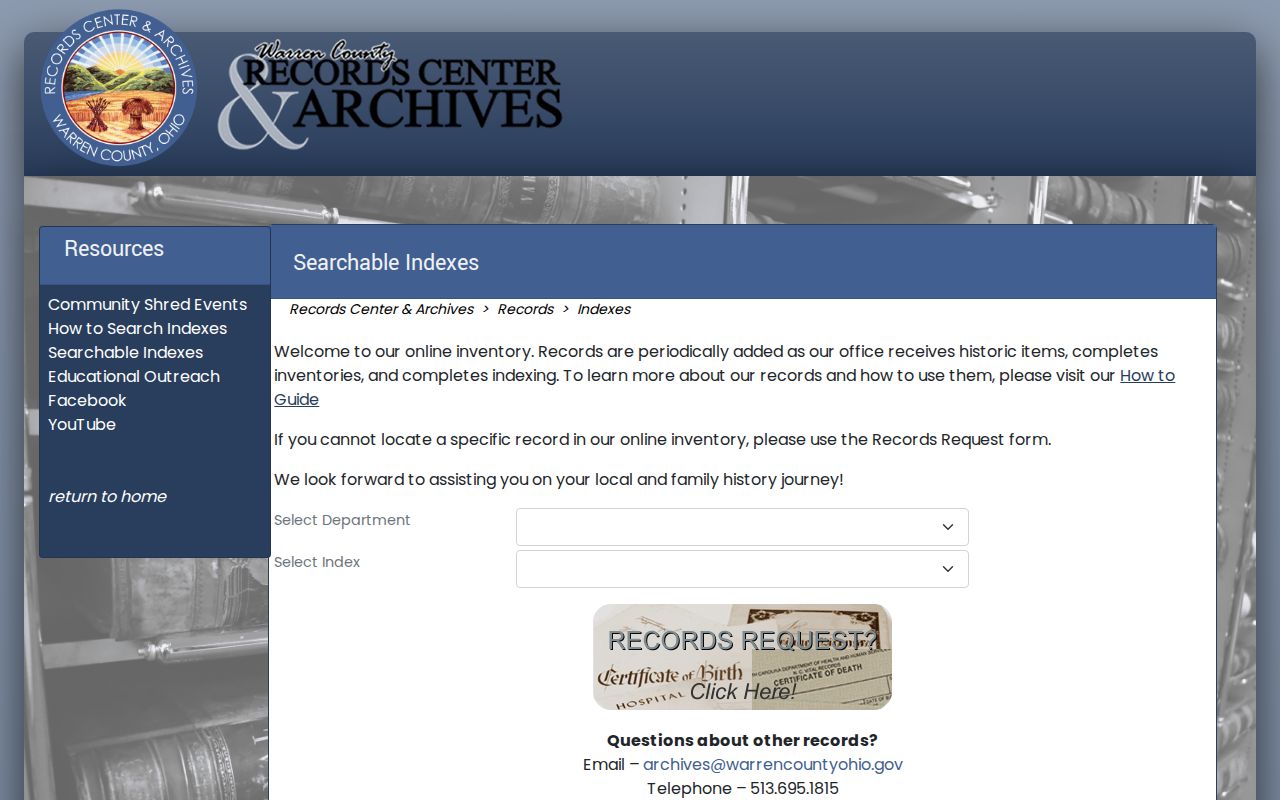
The archival index is a route to a concrete series, not a promise that every historic document image is online. It is particularly useful when a recorded party, map label, or legal description predates the most convenient online document access.
Deerfield Township Records Request Route
When an archive index identifies a likely record without an image, use the Records Center reading room, phone, email, or a narrow request. The official request form asks for the department, record type, township, first and last party, record date, additional information, and contact details. A phone or email is required for a response. County limits and archival handling rules still apply, but a focused request gives staff a usable record trail.
The historical-record request route is not a signal to speculate. Name the particular deed, map, estate packet, or court series sought; include the parcel, party, date range, volume/page, or document number when known. If a public record is held by another office, Ohio Public Records Act, R.C. 149.43, supports a focused request to the likely custodian.
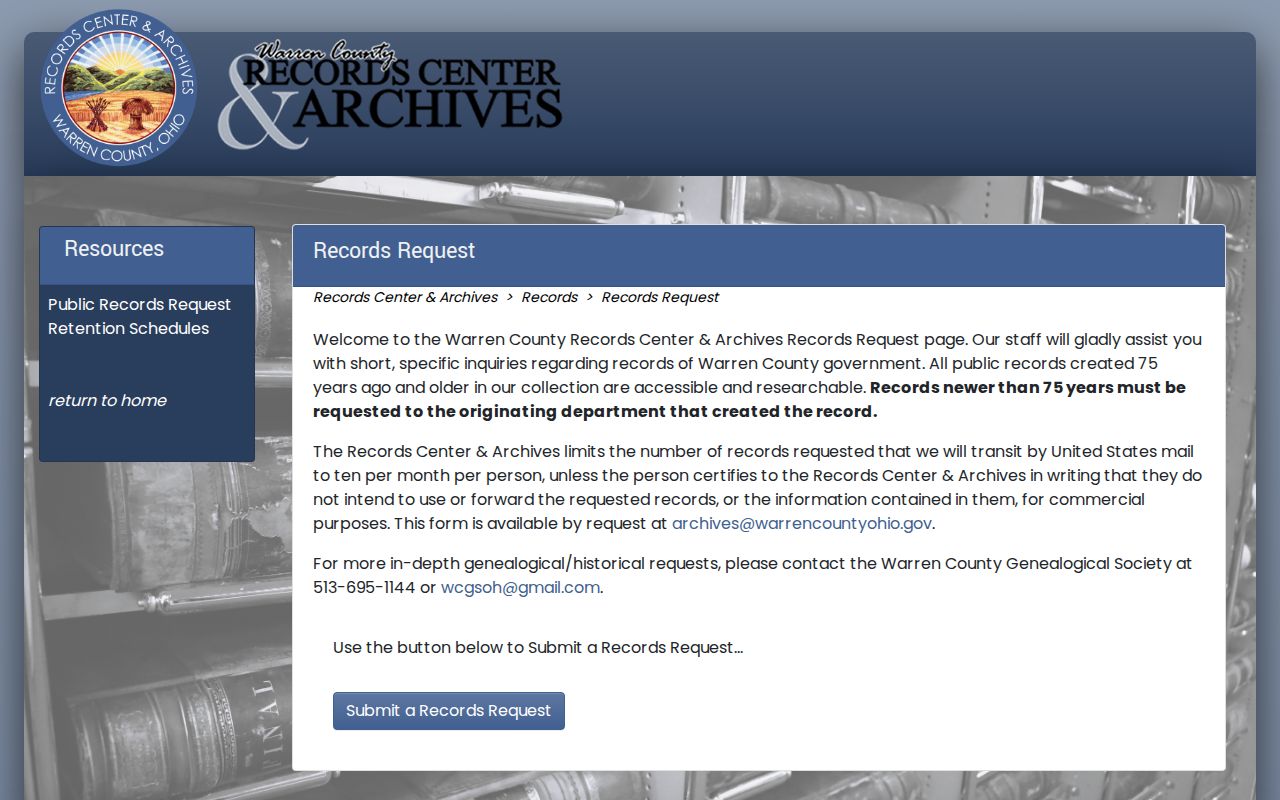
A specific request can also clarify whether a document is available for inspection, whether a releasable copy exists, and which office retains a newer record.
Deerfield Township Past Household Evidence
Recorded title and household history are different tracks. Pair an 1878 Wiggins county-directory lead with federal census schedules through 1950, then look for newspapers, obituaries, and probate material from the same period. The historical collections themselves are described with their limits on the Deerfield Township city directory page. No local reverse or criss-cross run was verified, so never assume an address-ordered list exists for the year in question.
- Set a time window from a recorded transfer, tax clue, or dated map label.
- Check a county-directory or phone-book lead only after confirming the repository and year.
- Pair the closest federal census with the name, locality, and household composition.
- Test the result against a newspaper notice, obituary, cemetery result, or probate packet.
- Return to the parcel and legal description if a historic place label differs from the current street address.
The 1875 and 1891 Township maps help with old landowner and place labels. They do not prove street renumbering, and no verified local renumbering date, Sanborn run, or dedicated house-history guide was found. Treat those gaps as a reason to check the Recorder, Archives, and WCGS rather than guessing continuity.
Deerfield Township Previous Residents Endpoints
Probate and cemetery records can close parts of an address story when a recorded party has died or an estate appears. Warren County Probate handles estates, guardianships, trusts, wrongful-death matters, adoptions, name changes, delayed or corrected births, and marriages. An estate file can identify a decedent, fiduciary, heirs, assets, and useful time clues, but it is not proof that named people remain in the area.
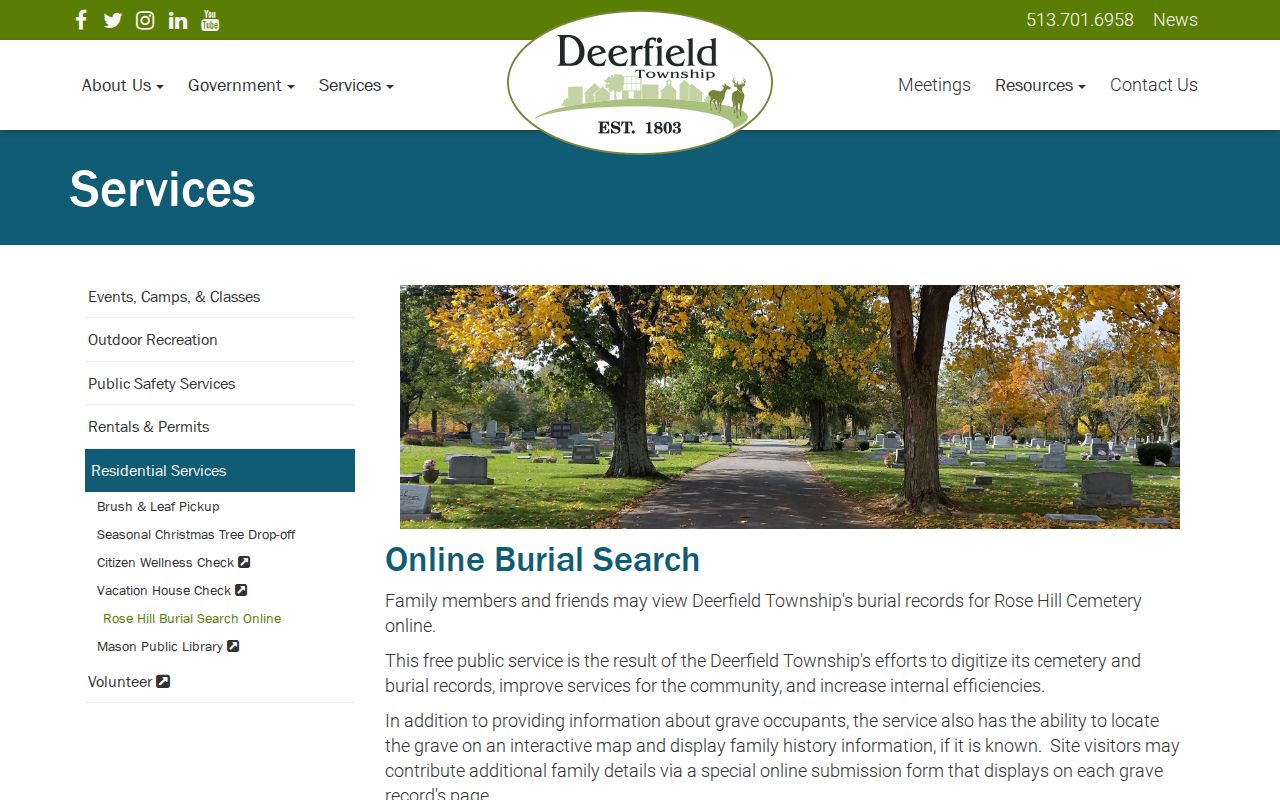
Rose Hill’s burial search is a Township historical-person resource with burial records, an interactive grave map, and family-history information when known. Use a result as a date and place clue, then corroborate it with an obituary, death record, probate file, census schedule, or recorded document.
King Mansion, built in 1855 in the Kings Mills industrial setting, is another useful place-history hook. It can guide a search toward maps, land plats, Recorder records, and newspapers, but it does not establish a particular person’s connection without supporting evidence.
Deerfield Township Records and Personal Boundaries
For a current property owner, the Recorder’s free Property Fraud Alert offers email, text, or phone enrollment for filings involving registered property. It is a monitoring notice, not a promise that harm will be prevented or that every filing is improper. Read an alert with the Recorder and the underlying recorded document before drawing a conclusion.
Previous residents research belongs to family history, house history, heir research, and lawful personal curiosity. Use only records you are permitted to inspect, respect protected information, and do not use a historical trail to track, harass, or harm a living person.
Research boundary. A recorded owner, a tax mailing contact, and a historic household clue are different facts; keep them separate and verify each with its custodian.